
Focus on Pet Dentistry
We practice the highest standard of care for all dental procedures
We now know that dental health plays in the overall health of our dogs and cats. The latest statistics say that approximately 75% of all dogs and cats over 3 years of age suffer from dental disease and we want to help put an end to that! Dr Robert Kay and our team of vets take great pride in having a full suite of the latest dental equipment to make sure you pet gets the best in pet dentistry! This includes using a nerve blocks for any necessary dental extractions. We take x-rays of any concerning teeth during the dental procedure so we can pick up any root disease that may be hidden by otherwise healthy looking gums. We take our role seriously and do our best to show you how to look after your pet’s teeth long term. Our dentals are ‘day procedures’ and require a general anaesthetic and hospitalisaton for the full day to allow us to monitor your dog or cat’s comfort prior to, during and then after their procedure.
Vet Dentistry Rockdale
Lift your dog’s lip or look inside your cat’s mouth, and the teeth tell you most of the story. Brown tartar along the gumline, a smell that has crept in, a back tooth you would rather not look at twice. That is the part a real dental sorts out, and at Rockdale Veterinary Hospital we do the whole job in one building at 335 Forest Rd in Sydney’s St George area. For pet owners looking for vet dentistry, Rockdale and the suburbs around it have a clinic that cleans below the gumline, takes dental X-rays and lifts a bad tooth in the one visit, rather than handing you a referral. The same care reaches neighbours booking vet dentistry in Bexley and vet dentistry in Kogarah. We are a fully equipped animal hospital for dogs and cats, family-owned since 2022. Call us on 02 9123 6888 and we will book your pet’s dental check.

What a Proper Pet Dental Actually Involves
A real dental for a dog or cat is more than a scrub of the tooth surfaces you can see. Here is what the day looks like with us. It starts with an examination and a frank conversation about your pet’s mouth, then a pre-anaesthetic health check so we know your animal is fit for the procedure. With your pet comfortably under general anaesthetic, we scale away tartar above and below the gumline, where the disease that matters actually sits, and polish every tooth. We take dental X-rays, because most of each tooth is hidden under the gum and a root problem will not show on the surface. If a tooth is too far gone to save, we extract it and carry out any minor oral surgery the mouth needs, with pain relief throughout. Your pet then recovers under our nurses’ care and heads home the same day. That covers the great majority of dogs and cats. The work is done in-house by Dr Robert Kay and the veterinary team. For the genuinely complex cases, advanced oral surgery, orthodontics, or root canal and other endodontic work, we refer to a veterinary dental specialist, so your pet sees the right hands for the job rather than us pushing past our limits.
Routine Dental Clean
- Price includes dental charting and a full mouth scale and polish under general anaesthetic
- Day procedure available Monday-Friday
- Any extractions required would incur additional charge that would be discussed with you prior to the procedure
What Does a Dog or Cat Dental Cost?
This is the question we hear most, and the honest answer is that it depends. The grade of dental disease, the number of teeth that need to come out, and how many X-rays the mouth calls for all change the figure. So rather than a guessed price, you get a clear estimate after the dental assessment, before anything goes ahead. For insured pets the cost lands lighter. We bill most pet insurers directly, so you pay only the gap rather than fronting the whole amount and waiting on a refund. We keep our pricing accessible on purpose, because a dog or cat in dental pain should not wait on a bill the family cannot plan for.

Why the Clean Happens Under Anaesthetic, and How We Keep It Safe
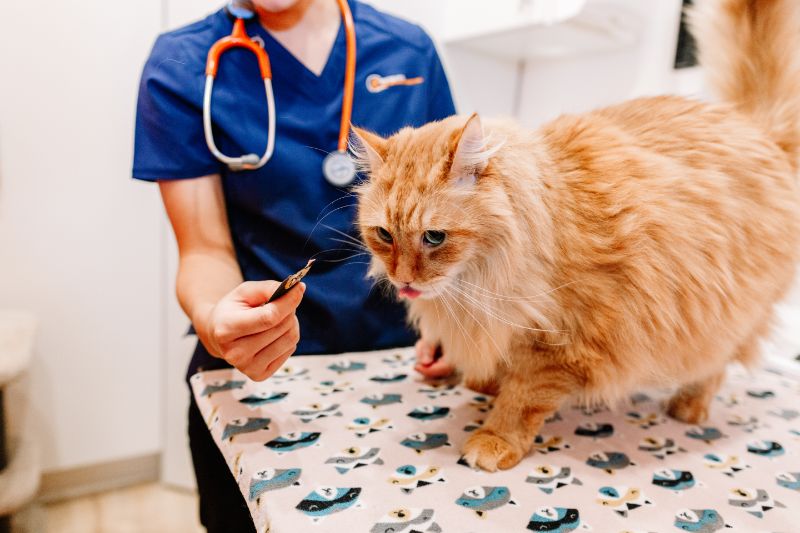
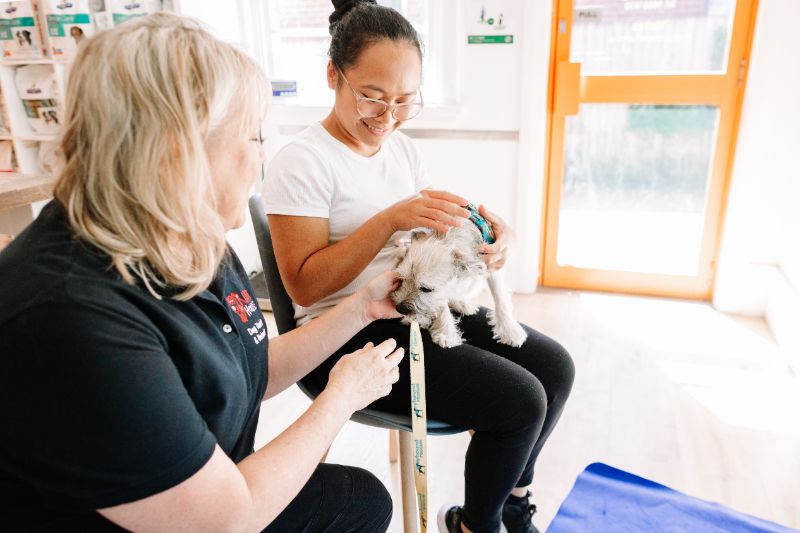
People sometimes ask whether the anaesthetic is really necessary, and the straight answer is yes for a clean that does any good. You cannot scale beneath the gumline, probe each tooth or take an X-ray in a mouth that is awake, and a conscious dog or cat will not hold still for the fine work where the real disease hides. A surface scrape on an awake animal looks tidier but leaves the part that matters untouched, which is why we do not offer it. Safe and monitored is the whole point. Before anaesthetic we run a health check and bloodwork to confirm your pet is a good candidate. Through the procedure your animal is on intravenous fluids, with a nurse monitoring their vital signs and pain relief given as needed. Our entire team is Fear Free certified, so the lead-up is calm too: we do not scruff cats or muzzle dogs, and we reach for gentle handling and calming medication to take the edge off before your pet ever reaches the table.
Spotting Dental Trouble Early in Your Dog or Cat
Dental disease is one of the most common problems we see, and it is easy to miss because pets are good at hiding a sore mouth. As a general guide, the signs worth a check are bad breath, yellow or brown tartar on the teeth, red or bleeding gums, dropping food while eating, pawing at the mouth, and going off harder food. None of these is proof on its own, but any of them is a fair reason to book a look. It is worth treating, and not only for comfort. Untreated dental disease is genuinely painful for an animal that cannot tell you, and the infection in a diseased mouth can affect other organs over time. Catching it earlier usually means a simpler procedure and fewer teeth lost, which is the case for a check rather than a wait.

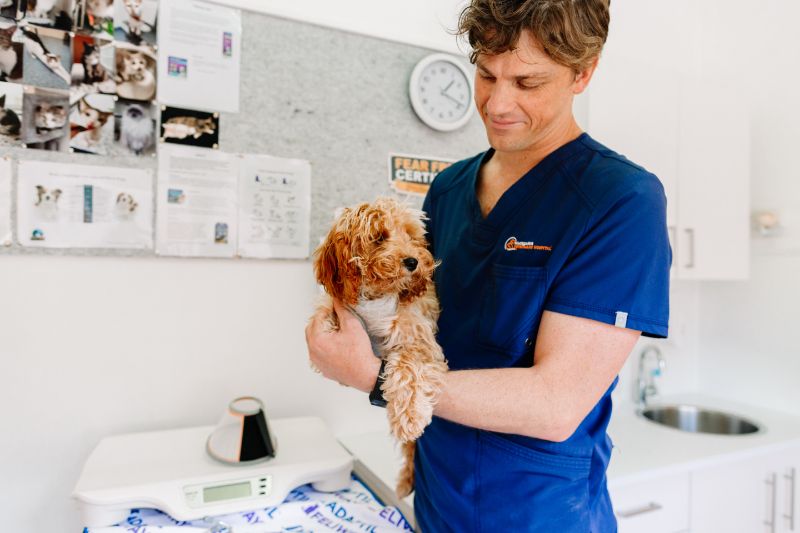
The Vet Doing Your Pet’s Dental Work at Rockdale Veterinary Hospital
The dentals here are led by Dr Robert Kay, owner and head vet. He is a Royal Veterinary College graduate with more than 20 years in practice and Fear Free qualified, working alongside a team of skilled veterinary nurses who handle the monitoring and after-care. That experience is what lets us read a dental X-ray, judge which teeth can be saved, and do the extractions and minor oral surgery in-house with confidence. Rockdale Veterinary Hospital is a family-owned practice, and around half of the pets we see come to us on a friend’s recommendation. Every patient gets an unhurried 30-minute standard consultation, with separate dog and cat consulting rooms so a nervous animal is not waiting nose-to-nose with the species it likes least.
Hours, Booking and Finding Us From Rockdale
A dental is planned care, so the first step is a check, and you can book one by phone on 02 9123 6888, by email at team@rockdalevets.com.au, or online any time. We are here 7 days a week: 8:00am to 7:00pm Monday to Friday, 9:00am to 5:00pm Saturday, 10:00am to 3:00pm Sunday, and closed on public holidays.
You will find us at 335 Forest Rd, Bexley, a short, ordinary drive from Rockdale and the neighbouring suburbs in Sydney’s St George area, the same clinic owners reach for vet dentistry in Hurstville, vet dentistry in Arncliffe and vet dentistry in Earlwood, with parking at the door. We are not a 24-hour hospital, so for an after-hours emergency between visits, Veterinary Specialists of Sydney handle it at 106 Parraweena Road, Miranda, on 02 8376 8767.
Book a Dental Check for Your Rockdale Pet
A dog or cat with a sore mouth rarely gets better on its own, and the sooner the teeth are checked the smaller the job tends to be. Book a dental check on 02 9123 6888 or online, and we will start with a proper look and a clear plan for your pet.
Questions Rockdale Pet Owners Ask About Dental Care

We take dental procedures very seriously. We use the latest in recommended anaesthetic techniques and monitoring and have all of the latest dental equipment at our finger tips to make the dental treatments as quick and effective as possible.


